Fire Risk Assessments
A Fire Risk Assessment is required under
The Regulatory Reform (Fire Safety) Order 2005 – therefore we deliver thorough, lawful, and reassuring
Fire Risk Assessments by combining our extensive experience in fire expertise with real-world understanding.
Professional and Expert Fire Risk Assessment
A Fire Risk Assessment entails a thorough examination of your property, encompassing both its interior and exterior, aimed at pinpointing potential fire hazards and risks. The primary objective is to reduce or eradicate these risks to a level that is safe and compliant with legal standards, thus ensuring your property is equipped with appropriate fire protection measures.
If you hold a position as an employer, owner, landlord, or occupier, or have authority over non-domestic premises, you are designated as the "Responsible Person" for fire safety. This encompasses roles such as facilities managers, building managers, managing agents, or risk assessors.
Why You Need a Fire Risk Assessment
The Regulatory Reform (Fire Safety) Order 2005 stipulates that individuals with any degree of authority over an organisation or premises must implement reasonable measures to mitigate fire risks and establish safe evacuation protocols in case of a fire.
Failing to carry out a suitable fire safety risk assessment undermines the safety of your property and can lead to enforcement action. Engaging an independent, certified, and regulated fire protection specialist like RiskFire ensures the assessment is completed to the required standard
Types of Fire Risk Assessments We Offer
01
Visual Check (Communal / Accessible Areas Only)
A basic assessment of shared spaces such as corridors, stairwells, plant rooms, and escape routes; no walls, floors, or ceilings are opened up.
Looks at:
- Fire doors
- Escape routes
- Signage
- Detection systems
- General fire safety management
Suitable for most buildings.
02
Intrusive Check (Communal / Accessible Areas Only)
Includes everything in Type 1, but also involves opening up parts of the building’s structure to check hidden compartmentation and fire-stopping.
Used when:
- Concealed defects are suspected
- Previous assessments raised concerns
Requires approval and reinstatement after inspection.
03
Visual Check (Communal Areas + Occupied Spaces)
Includes Type 1 checks and also extends into a sample of occupied areas, such as offices, units, bedrooms, storage rooms, or tenant spaces.
Looks at:
- Internal smoke alarms
- Escape routes within occupied rooms
- Fire doors between private and communal spaces
Helps ensure local practices don’t compromise overall safety.
04
Intrusive Check (Communal Areas + Occupied Spaces)
The most detailed assessment, combining the checks from Type 2 and Type 3.
Includes:
- Opening walls, ceilings, and service risers
- Investigating hidden construction details
- Checking concealed fire-stopping and compartment lines
More disruptive and typically used when serious fire safety issues are suspected.
Commercial Fire Risk Assessments
RiskFire carries out commercial Fire Risk Assessments
across all business and property types. Whether you need a Workplace Fire Risk Assessment for a single site, an Office Fire Risk Assessment for a managed building, or a scalable programme across a portfolio, our approach is built around the specific demands of your premises and sector.
No two buildings are the same, so we don't treat them that way. We assess your specific layout, occupancy, and use, then deliver a PAS-79 aligned report with clear findings and a prioritised action plan your team can act on straight away.
For businesses managing compliance across multiple locations, our FireHub platform report gives you a single view of all findings, scheduled reviews, and outstanding actions across every site.

User-friendly live system
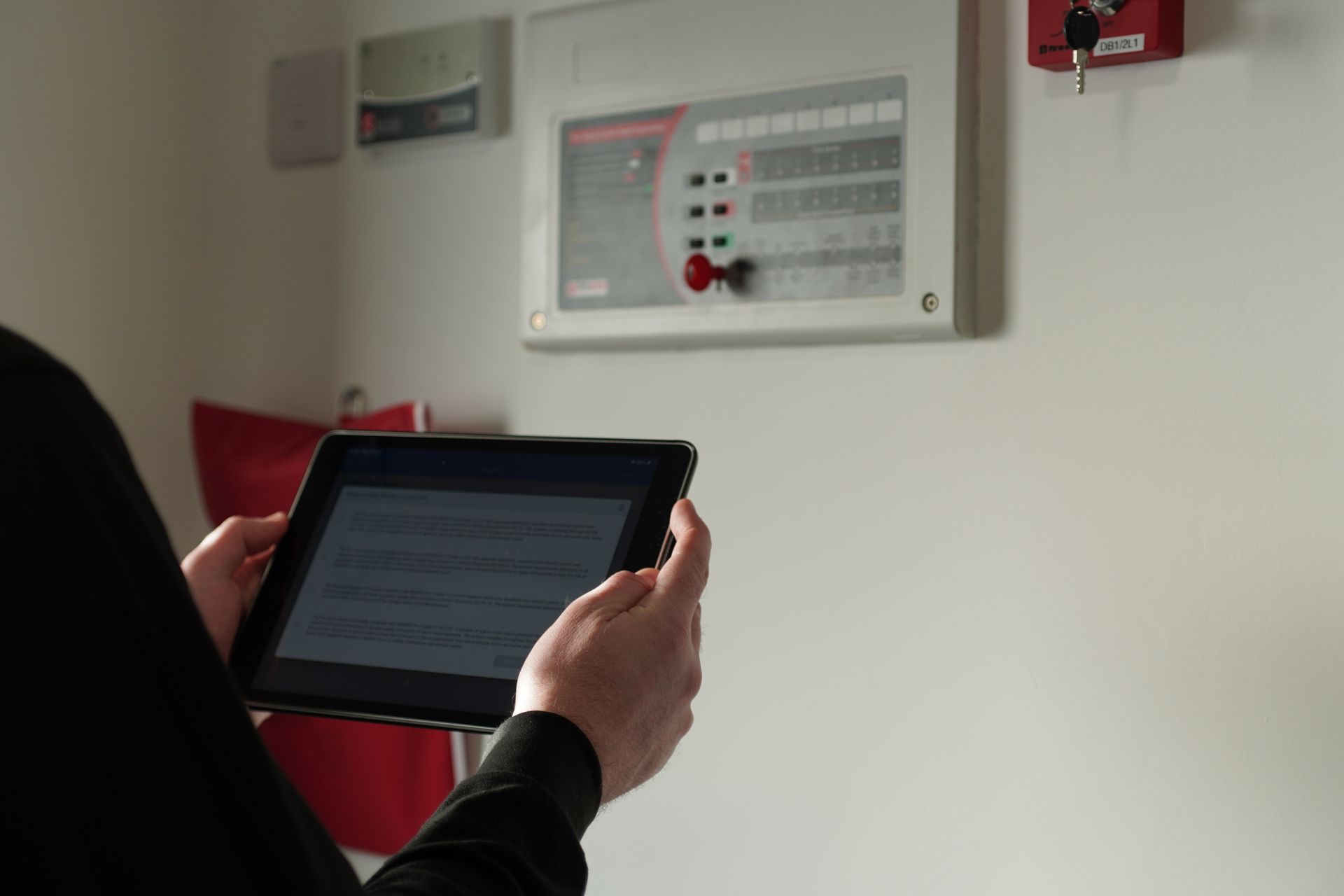
FireHub is a cloud‑based Fire Risk Assessment and record‑management platform designed for fire safety professionals, site managers and multi‐site operators. It allows users to carry out fire risk assessments using the PAS‑79 methodology, upload images instantly from tablets, set scheduling and reminder alerts, work offline, track significant findings across multiple sites and assign tasks to colleagues or contractors.

Why Choose RiskFire For Your Fire Risk Assessment?
At RiskFire, we provide comprehensive Fire Risk Assessments designed to keep your building, occupants, and property safe. Our team of UK-accredited assessors delivers practical, tailored advice to help reduce the risk of fire, taking into account the unique layout, use, and occupancy of your premises.
We combine thorough inspections with actionable recommendations, ensuring compliance with current UK fire safety legislation and standards. By choosing RiskFire, you benefit from clear reporting, expert guidance, and a personalised approach that helps you manage fire risks effectively while giving you confidence that your building is safe and compliant.
RiskFire – Your Trusted Fire Safety Partner!
Frequently Asked Fire Risk Assessment Questions
Who is required to have a Fire Risk Assessment?
All commercial properties, workplaces, and public buildings are legally required to carry out a Fire Risk Assessment, regardless of their size or industry.
What does a Fire Risk Assessment include?
Our assessments cover fire hazards, existing safety measures, the likelihood and potential impact of fire, evacuation procedures, and practical recommendations to reduce risk and improve compliance.
How long does a Fire Risk Assessment take?
The duration depends on the size and complexity of your premises, but most assessments are completed within a single day, followed by a detailed written report.
Do I receive a report after the assessment?
Absolutely, we provide a comprehensive, easy-to-understand report outlining hazards, risk levels, and practical recommendations to improve fire saftey and ensure compliance.
How often should a Fire Risk Assessment be carried out?
Typically, Fire Risk Assessments should be reviewed annually or whenever there are significant changes to the building, its layout, its use, or occupancy.
Are your Fire Risk Assessors certified?
Yes, all our fire risk assessors are fully qualified, experienced, and up-to-date with current UK fire safety legislation and standards.
Do you conduct Fire Risk Assessments for multiple sites or large organisations?
Yes, we offer scalable solutions for multi-site businesses, including consistent risk assessment procedures, centralised reporting, and a dedicated point of contact to ensure compliance across each location.
What are the legal consequences of not having a Fire Risk Assessment?
Failing to carry out a Fire Risk Assessment can result in legal penalties, substantial fines, or even closure orders. More importantly, it puts employees, occupants, and customers at serious risk.
Do you carry out commercial fire risk assessments for offices and workplaces?
Yes. Alongside our domestic services, we offer commercial fire risk assessments for offices, retail units, warehouses etc.
Our assessors understand the specific hazard profiles of different working environments and tailor each workplace fire risk assessment to the layout, occupancy, and use of your building.
Can you carry out a fire risk assessment for my business if I have multiple sites?
Yes. We offer scalable fire risk assessment services for businesses managing multiple locations.
Each site receives a tailored fire risk assessment for business following the same consistent methodology, with all findings, actions, and review dates tracked centrally through our FireHub platform.
Can a fire risk assessment be carried out on a commercial property that is currently tenanted?
Yes. Commercial fire risk assessments can be carried out on occupied premises with minimal disruption to tenants or day-to-day operations.
Where access to individual units is needed, we coordinate directly with you to agree a schedule.